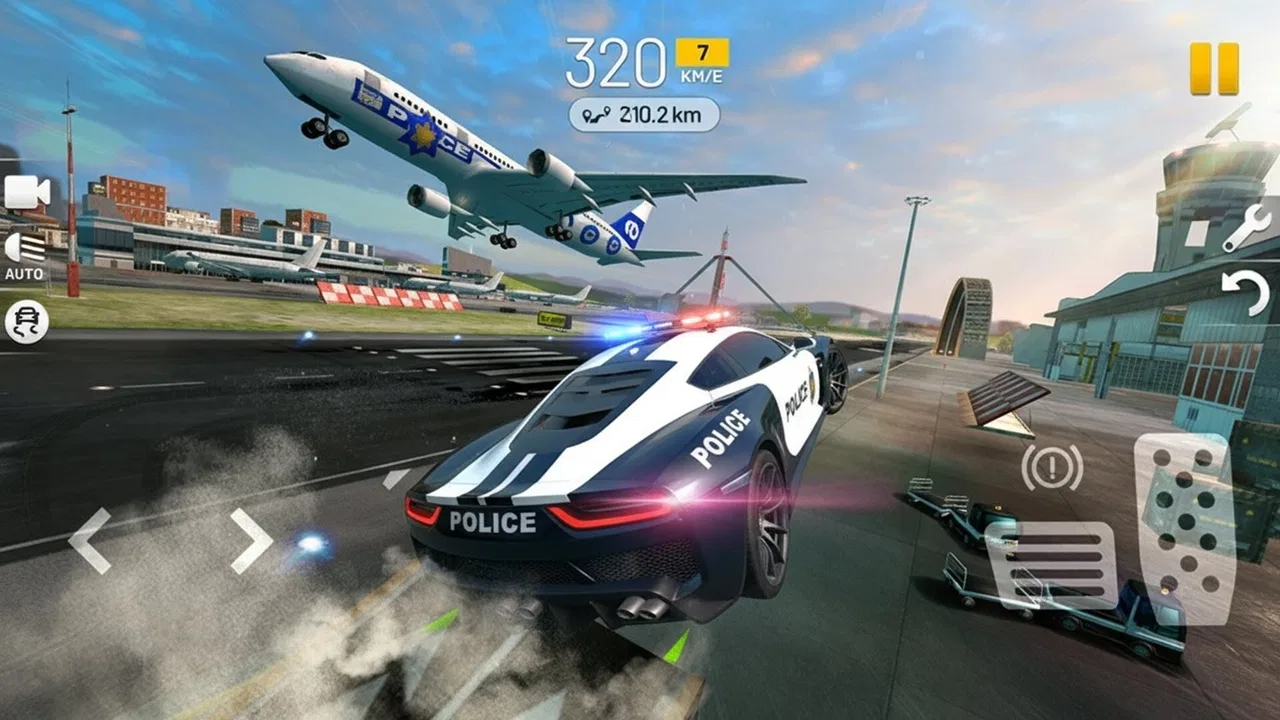
Police Car Chase: Police Games
- 3.8
- Rating
- 5.00M
- Installs
- Free
- Price

 Analysis by App-foxy
I went into Police Car Chase: Police Games expecting a quick, uncomplicated racing game, and that is exactly where it makes the most sense. Developed by Emerging Games Studio, it puts the focus on driving a police car after criminals rather than building a large open-world police simulation. The basic appeal is immediate: get behind the wheel, pursue the target, and try to finish the chase successfully.
That straightforward design makes it approachable for a first-time player. You do not need to learn a complicated career system or understand a deep racing setup before enjoying the central idea. At the same time, the game is not a perfect fit for everyone. Players looking for realistic police procedures, detailed vehicle tuning, or a broad story campaign may find the experience too light. I see it more as a pick-up-and-play chase game for short sessions.
What to expect when you start chasing
The game belongs to the racing category, but its identity comes from the police pursuit theme. Instead of competing only for a position on a conventional track, I found the motivation comes from staying focused on the criminal vehicle and bringing the chase to a successful conclusion. That small change gives familiar driving controls a clearer purpose.
You May Also Like

 Blood Strike: 2.5 Anniversary
Blood Strike’s Loadouts Turn Every Drop Into a Tactical Gamble
A close look at Blood Strike’s custom loadouts: how fast access to signature weapons reshapes its battle royale rhythm, rewards preparation, and narrows the gap between fights.

 Pandora - Music & Podcasts
Pandora’s Music Is Easy to Start, but Harder to Recover
Pandora’s strength is its low-effort path from a seed to a station. Its weak spot is how much confidence it asks you to place in connection, setup, and quiet recovery.

 8 Ball Pool
 Is Built on Rivalries, Rematches, and Routine
A close look at the rivalries, rematches, shared routines, and unanswered safety questions that turn a quick pool match into a persistent mobile community.

 Samsung Music
’s Quiet Strength Is Playing What You Already Own
Its reach comes less from spectacle than from dependable access to a personal library. That simplicity is both the app’s strongest retention engine and its ceiling.

 AccuWeather: Weather Radar
AccuWeather Review: A Quick, Clear Forecast for Everyday Decisions
For everyday plans, the best forecast is the one you can understand quickly. AccuWeather makes rain timing, radar, and local conditions easy to act on, with a few trade-offs.

 Hill Climb Racing
Why Hill Climb Racing Still Turns Crashes Into One More Run
A tiny car, a bumpy hill and one more upgrade: Hill Climb Racing keeps resurfacing because its simple chaos makes every near-miss feel personal.
More From Our News Desk



The store summary describes the central task well without needing much explanation: you chase criminals in a police car and try to bring them to justice. In practice, that means the first few minutes are best spent learning how the vehicle responds. I recommend resisting the temptation to drive at maximum speed immediately. A controlled approach helps you understand turns, braking, and the amount of space needed to react when the pursuit changes direction.
Because it is free to download, it is easy to try without making an upfront purchase. Optional in-app purchases range from $0.99 to $19.99 per item, so I would treat spending as something to consider only after you know whether the chase format suits you. The Teen content rating is also worth keeping in mind for families choosing games for younger players.
The game has attracted over 5 million installs, which suggests that its simple police-driving premise has broad appeal. Its average rating is 3.8, a useful sign that the experience works for many players but is not universally loved. My reading of that balance is that expectations matter: approach it as an accessible arcade-style pursuit game, not as a full police simulator.
The most enjoyable use case for me is a short break when I want something active but do not want to commit to a long session. A quick chase gives me a clear objective, and the police theme makes the driving feel more purposeful than an ordinary endless road game. It can also work for someone who enjoys testing reactions and learning routes through repetition.
On the other hand, I would skip it if your main reason for downloading a racing game is competitive multiplayer, licensed cars, or highly realistic handling. Those expectations point toward a different kind of racing experience. This title is strongest when you want the fantasy of being in pursuit and prefer a simple goal over a large collection of systems.
Why the first chase can feel harder than expected
New players may assume that speed alone wins a pursuit. I found the opposite approach more useful. A chase is easier to manage when I keep enough control to recover from a mistake. Oversteering into a turn can cost more time than taking a slightly safer line, especially when the target is already moving away.
My practical tip is to use the opening moments as a calibration period. Notice how quickly the police car reaches its useful speed, how much room it needs to slow down, and whether the safest route is the shortest-looking one. This is a small habit, but it turns the first meaningful success from a lucky run into something repeatable.
Setting up a comfortable first session
Installation is a sensible starting point for anyone using an older Android device because the game supports Android 7.1 and later. After opening it, I would begin with the default experience rather than immediately looking for purchases or trying to optimize everything. The goal of the first session should be familiarity: identify the basic driving input, understand what the chase asks you to do, and learn how the game communicates success or failure.
I also recommend playing the first attempt somewhere you can concentrate. Police pursuits reward quick visual decisions, and a noisy environment makes it harder to notice a turn or react to a sudden change. This is not a game that requires a long preparation routine, but giving the opening chase your full attention makes the controls easier to judge.
Before spending anything, play enough to decide whether the core loop is enjoyable on its own. The free entry point is valuable here because the central question is not whether the theme sounds appealing; it is whether you like repeating the driving-and-pursuit cycle. If the act of following, positioning, and finishing a chase feels satisfying, optional purchases become a personal convenience decision rather than a requirement for discovering the game.
The current version is 8.9, so I would make sure the installed copy has finished updating before judging the experience. Version information matters especially when a player follows older advice, because menus and handling can change over time. I would base my own routine on what appears in the current installation rather than assuming that every video or comment describes the same build.
One useful setup choice is deciding what kind of session you want. If I have only a few minutes, I focus on one clean attempt instead of trying to master everything at once. If I have more time, I use repeated runs to identify where I lose control. Separating those goals prevents a failed chase from feeling like wasted time.
A simple first-session routine
Start the first chase without buying anything and pay attention to the basic driving response.
Use a gentle approach to turns so you can see how much recovery room the car needs.
After a failed attempt, change one habit at a time instead of driving more aggressively everywhere.
Repeat the route only when you understand why the previous run ended unsuccessfully.
This routine is deliberately modest, but it gives a new player a clear path from installation to a first useful result. The important milestone is not simply reaching the end of a run. It is knowing which driving decision helped you get there.
Turning the first chase into a successful action
My first meaningful success would be completing a pursuit with deliberate control rather than relying on frantic movement. The best way to reach that point is to divide the chase into three mental tasks: follow the target, preserve control, and close the distance when the road allows it. Thinking this way makes the experience less overwhelming.
During the following phase, I keep the police car positioned so that I have time to respond. Hugging every corner may look fast, but it leaves less room for correction. A slightly wider line can be more effective for a beginner because it reduces the chance that one poor turn ruins the entire attempt.
When the target begins to pull away, I avoid making several risky decisions at once. I first stabilize the car, then look for the next opportunity to gain ground. This is one of the less obvious lessons in a chase game: the fastest recovery is often safer than an ambitious shortcut or sudden correction. Even without a complex upgrade system, decision quality can make the simple driving loop feel more rewarding.
If you keep failing at the same point, do not automatically blame the speed of the car. Watch your timing. Entering a turn too quickly, correcting late, or focusing on the target instead of the road can produce the same result. I found that naming the mistake makes the next attempt more useful than simply starting over with more effort.
A realistic everyday scenario is playing during a commute break or while waiting for an appointment. In that situation, I would choose one objective: complete a controlled chase or learn one difficult section. That keeps the session satisfying even if I do not finish every attempt. The game’s direct premise supports this kind of short, focused use better than racing titles that require long events or extensive preparation.
Another practical use is sharing the game with a friend who enjoys casual driving challenges. Rather than presenting it as a serious simulation, I would frame it as a quick test of pursuit control. That description is more honest and helps avoid disappointment from someone expecting a detailed law-enforcement role-playing experience.
What makes a good run feel different
A good run is not necessarily the one with the most aggressive driving. For me, it is the attempt where the car stays predictable. Predictability lets me concentrate on the target and the route instead of constantly correcting the vehicle. Once that happens, the chase becomes less like random swerving and more like a sequence of choices.
I also pay attention to how much mental energy the game demands. The basic concept is easy to understand, but reacting repeatedly can become tiring if I play for too long. Short sessions are a strength here, while extended play may expose the limited depth of a focused police-chase format. Taking a break after several attempts can preserve the fun and prevent frustration from turning into a negative judgment.
Common confusion and the limits of the experience
The biggest possible misunderstanding is expecting the word “police” to mean a complete police simulation. This is primarily a racing game built around pursuit. I would not download it expecting investigations, case management, detailed patrol routines, or a large narrative campaign. Its satisfaction comes from driving and chasing, not from managing every part of police work.
Another point of confusion concerns progression. Players who are used to racing games with extensive vehicle collections and deep customization may find this experience comparatively focused. That is not automatically a flaw, but it changes how I evaluate it. I judge the game by how enjoyable the central chase feels, not by whether it contains the same breadth as a major console-style racer.
Optional purchases can also affect how different players view the game. Since items can cost from less than a dollar to nearly twenty dollars, I would not make a purchase during the first session. First establish whether the free experience gives you enough entertainment. If it does, you can decide later whether an item adds meaningful convenience; if it does not, spending more is unlikely to fix a mismatch with the core gameplay.
The rating of Teen means parents should make their own suitability decision rather than assuming that a police theme is automatically appropriate for every child. I would also remember that a game can be easy to understand while still demanding quick reactions. Younger players may enjoy the premise, but the best choice depends on their comfort with the content and driving challenge.
Compared with a conventional arcade racer, this game offers a clearer role and objective. You are not simply trying to look fast on a track; you are pursuing a target. Compared with a realistic driving simulator, however, it is likely to feel less concerned with authentic procedure and technical detail. That comparison explains who should choose it: players who want a themed, accessible chase rather than a precise recreation of professional driving.
There is also a trade-off between immediacy and depth. The direct design helps me start playing quickly, but it may not provide enough variety for someone who wants a long-term hobby. If you enjoy mastering one compact loop, that focus can be welcome. If you need constant new modes, extensive progression, or a broad social competition layer, another racing game would probably serve you better.
When I would recommend skipping it
I would recommend skipping this title if you dislike repeating driving attempts, because learning through retries is part of the appeal. I would also look elsewhere if you need a story that develops your character, a realistic law-enforcement setting, or a large garage of vehicles to manage. Those are not small preferences; they define a different type of game.
I would be cautious about recommending it to someone who becomes frustrated by imperfect runs. The chase format encourages experimentation, and not every attempt will feel smooth. A patient player can turn mistakes into useful information, while a player seeking immediate mastery may find the same design irritating.
For a first-time user, the most reassuring point is that failure does not need to be treated as a verdict on your ability. Use each attempt to isolate one issue: braking, turning, positioning, or timing. That approach produces progress even before the chase is completed successfully.
Choosing the next step after the first success
Once you complete a chase, I would not rush straight into spending money or searching for advanced strategies. First decide what made the successful run enjoyable. If it was the feeling of closing the gap, focus on smoother positioning. If it was the quick reaction challenge, try to improve your consistency. If the police theme was the main attraction, consider whether the available variety keeps that fantasy fresh enough for continued play.
Players who enjoy the core loop can use short personal goals to create more structure. Try to finish a run without a major collision, maintain control through a difficult section, or repeat a successful approach instead of relying on luck. These goals do not require invented systems or extra equipment; they simply make the existing driving challenge easier to evaluate.
I would also set a sensible spending boundary. Because the game is free and offers optional items, the best next step is to confirm that the base experience earns more of your time before it earns your money. A purchase should solve a specific problem you have identified, not be an automatic part of installation.
Emerging Games Studio has made a game with an immediately understandable hook: police driving with a pursuit objective. Its strengths are accessibility, a clear theme, and the ability to deliver a focused racing session without demanding that I learn a complicated world first. Its weaknesses are equally important: the narrow concept may feel repetitive, and players wanting simulation depth or extensive racing features should choose another option.
My final recommendation is conditional but positive. If you want a free police-themed racing game for quick attempts, and you are comfortable improving through repeated chases, it is worth trying. Start slowly, learn how the car reacts, and judge the game after you have completed a few purposeful runs rather than one rushed attempt. Its best quality is the direct path from opening the game to understanding what you are meant to do.
For me, that clarity is enough to make it a reasonable casual download, especially when I want a short burst of driving action. I would keep expectations grounded, avoid treating optional purchases as necessary, and move on to a deeper racing alternative if the pursuit loop stops feeling fresh. Used on its own terms, Police Car Chase: Police Games is a simple, accessible way to turn a few spare minutes into a focused police pursuit.
FAQs for Police Car Chase: Police Games
01What is Police Car Chase: Police Games about?
Police Car Chase: Police Games is an action-driving game centered on police pursuits, patrol missions, and high-speed chases. You typically drive police vehicles through city environments, follow suspects, avoid obstacles, and complete objectives under pressure. The gameplay focuses on quick reactions, steering, and pursuit tactics rather than realistic law-enforcement simulation, making it suitable for players who enjoy casual driving and police-themed missions.
02Can I play Police Car Chase: Police Games offline?
The game may support offline play for its main driving and chase missions, which is convenient when you do not have Wi-Fi or mobile data available. However, certain features can still require an internet connection, including advertisements, analytics, updates, online rewards, or optional purchases. It is best to launch the game once while connected and check which modes remain accessible after switching to airplane mode.
03Is Police Car Chase: Police Games free to download and play?
Police Car Chase: Police Games is generally offered as a free download, allowing you to start playing without paying an upfront purchase price. Like many free mobile games, it may include advertising, optional in-app purchases, or progression systems connected to vehicle upgrades and rewards. Before downloading, review the store listing for current pricing, available purchases, and any age or payment restrictions associated with the game.
04What devices are compatible with the game?
Compatibility depends on the version available for your Android or iOS device, as well as the operating system requirements stated on the official app store page. The game should run best on relatively recent phones and tablets with enough free storage and memory. Older devices may experience longer loading times, reduced graphics quality, frame-rate drops, or occasional crashes, particularly during busy chase scenes.
05Does the game offer realistic police driving or multiplayer gameplay?
Police Car Chase: Police Games is better approached as an arcade-style police driving experience than a fully realistic simulator. Expect accessible controls, dramatic pursuits, missions, and action-focused challenges rather than detailed police procedures or advanced vehicle physics. Multiplayer availability can vary by version; if online competition is important to you, check the current store description because some editions may focus entirely on single-player missions.
Pros
- Simple controls make driving easy for casual players.
- Short missions are convenient for quick gaming sessions.
- Police vehicles add variety to the standard chase gameplay.
- Offline play is useful when you have no internet connection.
- Progression gives you reasons to keep unlocking new challenges.
Cons
- Repeated chase scenarios can feel monotonous after extended play.
- Aggressive ads may interrupt gameplay between missions.
- Vehicle handling can feel slippery during sharp turns.
- Some upgrades may require considerable time to unlock.
- Graphics look basic compared with more advanced racing games.

Police Car Chase: Police Games
Gallery